
Now more than ever, many children and youth are exposed to potentially traumatic events, whether it be from community or school violence, natural disasters, or the sudden loss of a loved one. Nationally representative surveys of youth and caregivers, in fact, suggest that approximately two thirds of youth are exposed to at least one traumatic event by late adolescence.1 Students who experience trauma without receiving necessary supports are at increased risk for a range of negative outcomes, including poor academic performance, emotional and behavioral regulation problems, dropping out of school, and delinquency.2,3
What is the Handle With Care Program?
Developed by West Virginia Center for Children’s Justice (WVCCJ) staff in 2013, Handle With Care is a school-community partnership program that helps ensure children potentially exposed to trauma in their home, school, or community receive appropriate support to help them achieve in school. Handle With Care fosters collaboration among various local agencies such as law enforcement, emergency medical services, fire departments, mental health service providers, and schools. A central component of Handle With Care is first responders providing schools with a “heads up” when a child has been identified at the scene of a potentially traumatic event. First responders are trained to identify children at the scene, find out where they go to school, and send the school a confidential notice that simply says, “Handle [child name] with care” without any other details.
The overarching vision for the Handle With Care program is that collaboration among local agencies and schools to identify students present at the scene of potentially traumatic incidents will result in improved trauma-sensitive supports to students within the school setting, which will lead to improved school climate, which will ultimately lead to improved student emotional, behavioral, and academic outcomes.
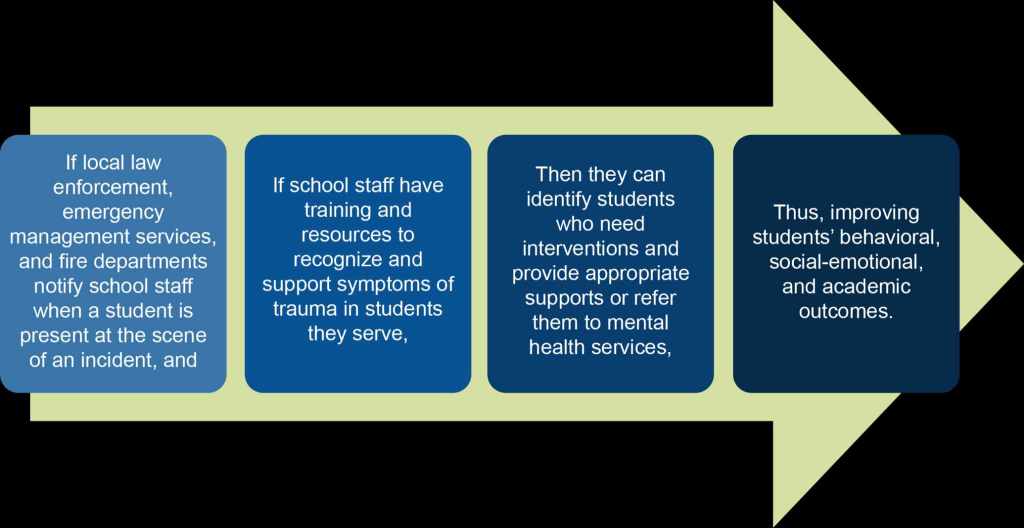
Handle With Care Theory of Change
What does the Handle With Care program include?
Through a grant from the Office of Juvenile Justice and Delinquency Prevention (OJJDP), researchers at SRI Education partnered with the founder of Handle With Care and Berkeley County Schools in West Virginia to build upon the initial Handle With Care program (Version 1.0) in important ways, resulting in Handle With Care Version 2.0.
What research has been done on the Handle With Care program?
Berkeley County Schools began implementing Handle With Care Version 1.0 in 2017. As part of the OJJDP grant, six schools in Berkeley County began implementing the enhanced Handle With Care Version 2.0 in 2021. During this time, the WVCCJ contracted with a team at SRI Education to conduct an evaluation of the Handle With Care program. The study addressed questions about the implementation of the program in schools and the impact it had on school, staff, and student outcomes by examining three groups of schools:
5 schools implementing Handle With Care Version 1.0 in Berkeley County
6 schools implementing Handle With Care Version 2.0 in Berkeley County
3 schools located in a different county that were not consistently implementing Handle With Care.4
In reviewing implementation of the Handle With Care Version 2.0, the evaluation team found that partner agencies attended the quarterly meetings, participated in the trainings, and found them overwhelmingly useful in supporting their program goals.
In examining program outcomes, the most promising findings were that school staff in Handle With Care Version 2.0 schools provided significantly higher ratings of schoolwide use of trauma-sensitive practices and school climate than staff in other groups. School staff who had implemented either version of Handle With Care also reported greater knowledge about trauma, confidence in using trauma-sensitive practices, and use of trauma-sensitive practices than staff in the comparison county. The study did not find impacts on student outcomes; however, it may take longer than one school year to see changes in student outcomes as a result of implementing the Handle With Care program.
The findings from the evaluation team’s study of Handle With Care 2.0 provide promising evidence of the program’s ability to positively impact school climate and schoolwide support for the use of trauma-sensitive practices. Future research should shed light on the long-term impacts of Handle With Care 2.0 on students’ social-emotional, behavioral, and academic outcomes

